
Max Pain in context
Read Max Pain correctly — including why this app shows it per-expiration but never for TOTAL.
Switch your app's expiration selector to a single Friday and you'll see a blue Max Pain marker land on the GEX chart. Switch it to TOTAL and the marker vanishes. That isn't a bug — it's the entire reason this lesson exists.
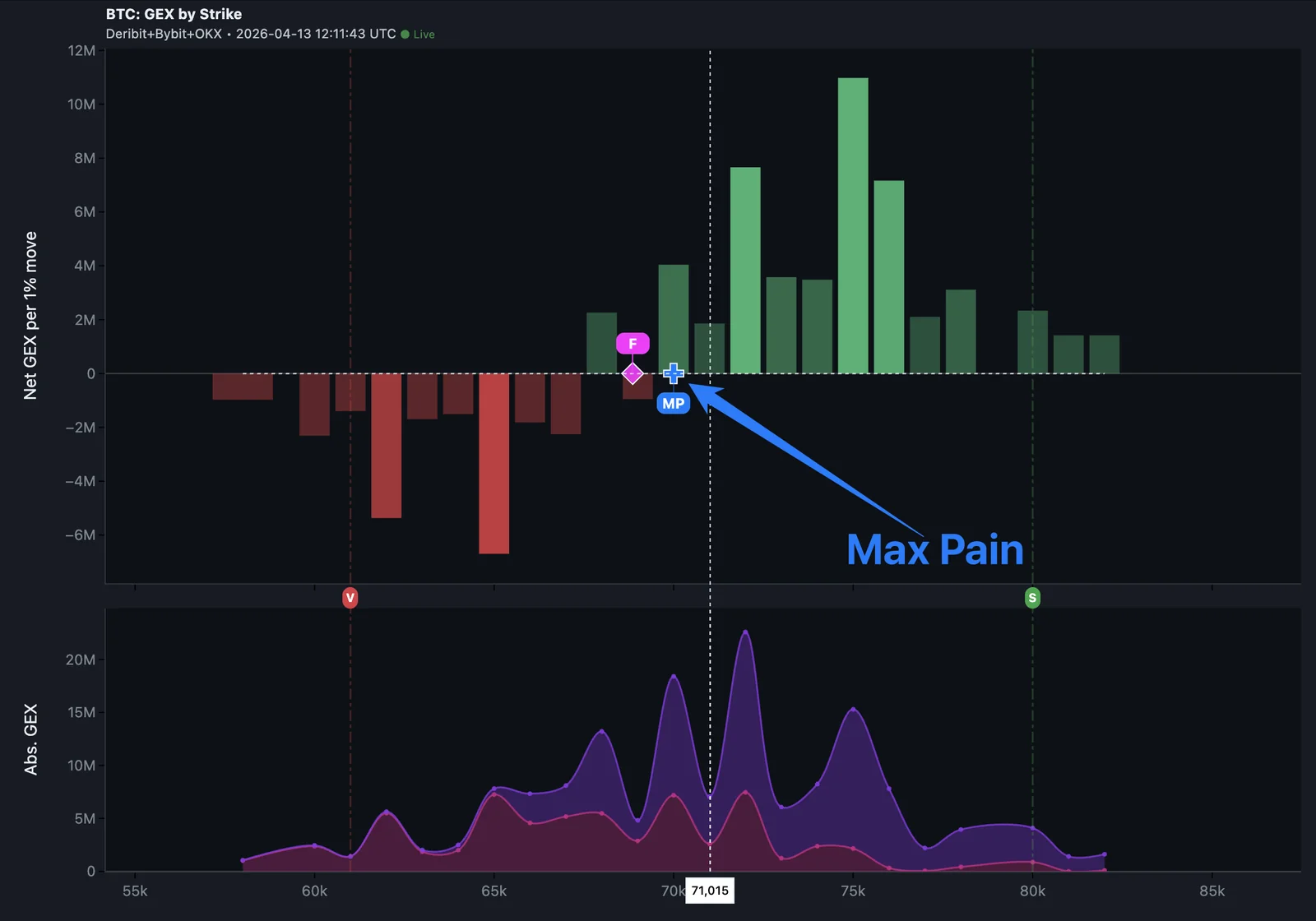
What Max Pain is
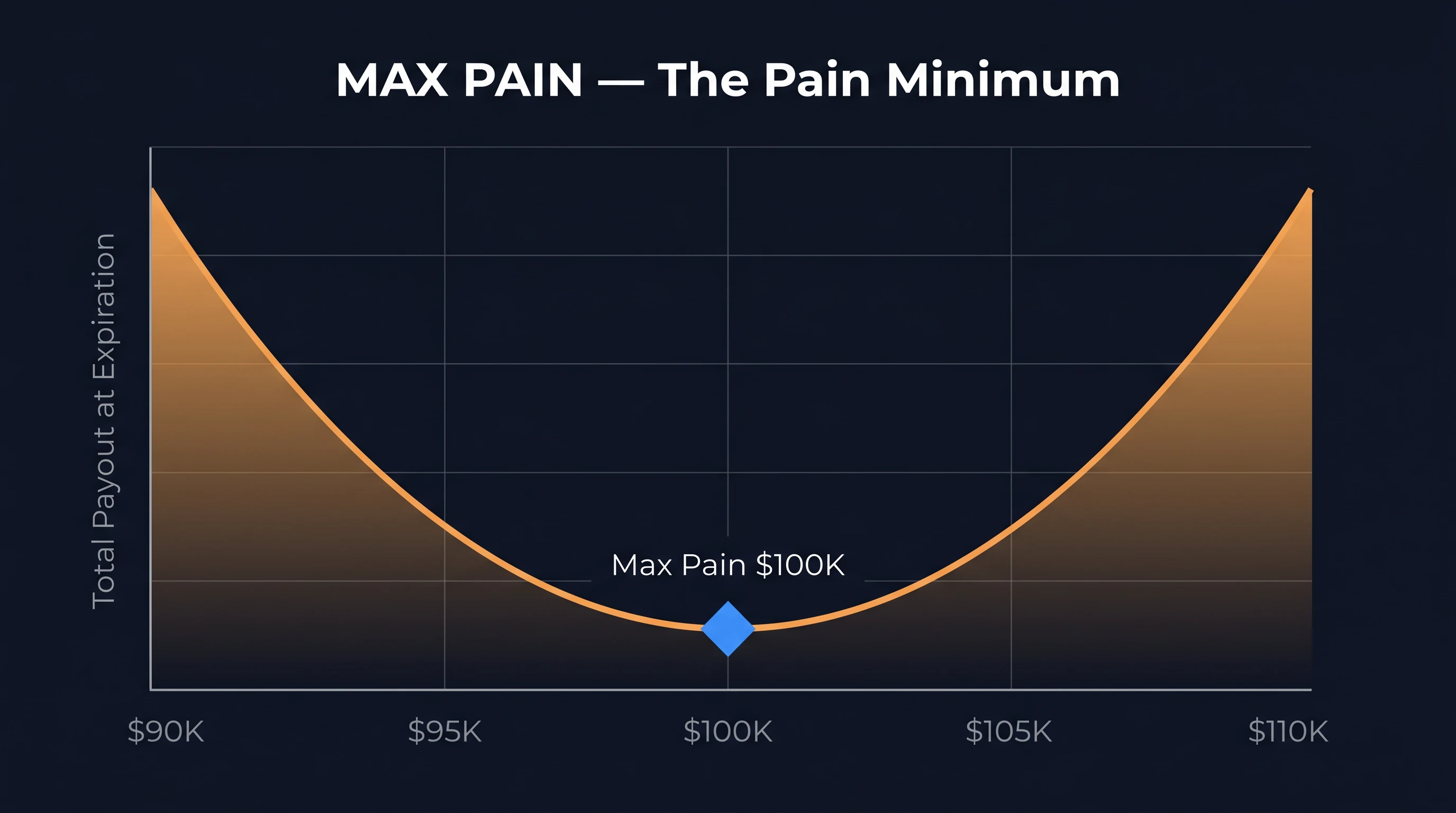
For each candidate strike at expiration, you can compute: how much would option holders collectively lose (and option sellers collectively gain) if spot settled exactly at this strike?
The strike that maximizes that total loss-to-buyers is Max Pain. No Greeks, no vol surface — just open interest and intrinsic value at each candidate strike.
Why this app hides TOTAL Max Pain
Combine every expiration into one TOTAL view and the math breaks. Here's a concrete case.
On February 10, 2026, BTC traded at $68,662. The Flip Point sat at $70,841. Per-expiry Max Pain for that Friday was around $70,000 — both within 3% of spot, both structurally close to the action.
TOTAL Max Pain was $82,000 — sitting $11K+ above the Flip Point, dragged there by 3–12 month OI parked at round-number call strikes ($100K, $120K, $150K).
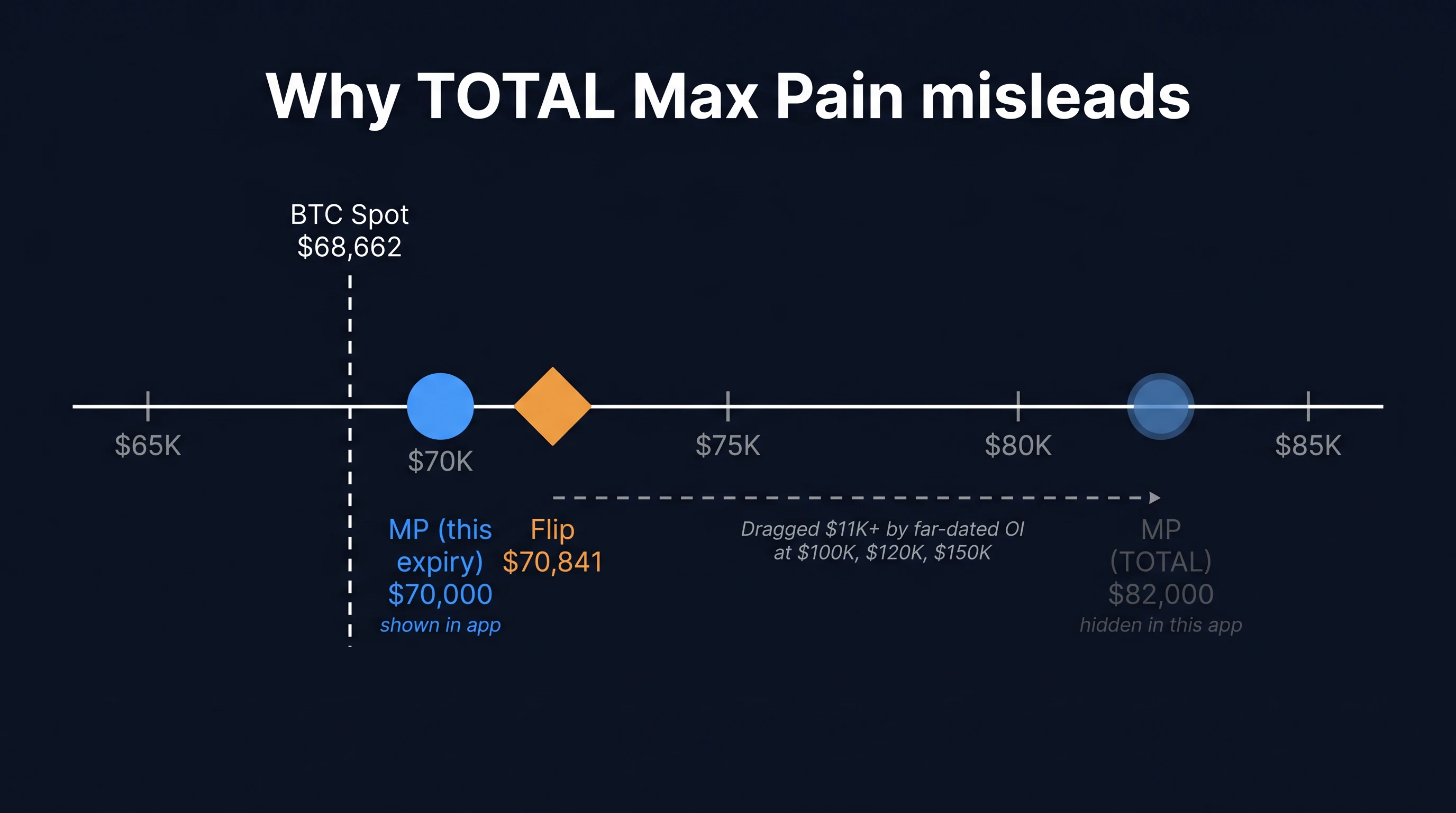
Those far-dated calls aren't pinning anything this week. Their gamma is near zero. But they fully count in the raw OI math behind Max Pain.
The Flip Point uses gamma-weighted math, which naturally filters out that far-dated OI. Max Pain doesn't — and an aggregated MP marker on a TOTAL chart would mislead more often than it helped. So this app hides it.
When to use it, when to ignore it
Max Pain has a real, observable pinning effect — but only in a narrow window. The rest of the time it's a weak signal dressed up as a strong one.
The narrow window is the last 2-6 hours before Friday 08:00 UTC, with concentrated OI around at-the-money strikes and a quiet macro calendar. Inside that window, dealer hedging concentrates around at-the-money strikes; gamma is enormous, re-hedging is constant, and the cumulative effect is to dampen moves and pin price. Outside it, the pin doesn't have an enforcement mechanism.
| Condition | Use Max Pain? | Why |
|---|---|---|
| Last hours of expiry | ✅ Primary | Dealer gamma is enormous; the pin is real |
| >24h to expiration | ⚠ Weak tiebreaker | Gamma not yet concentrated; Flip dominates |
| Low-OI venue | ❌ Ignore | Thin OI = no enforcement mechanism |
| Macro event day | ❌ Ignore | Exogenous flow swamps dealer hedging |
| MP and F disagree >1-2% | ❌ Trust the Flip | Flip reads the whole book; MP reads one expiry |
Don't let Max Pain become a single-number trade thesis. It's one input among several.
The takeaway
Useful in a narrow window — the final hours of an expiry, when OI is concentrated and macro is quiet. Hidden in this app where the math breaks (TOTAL view). One input among several — never a single-number trade thesis.
Next lesson: putting it all together — your first full read on BTC.
Useful in the last hours. Misleading the rest of the time.
Check your understanding
What is Max Pain, in one sentence?
The strike at which the largest combined notional of options would expire worthless — i.e., where the most premium gets transferred from option buyers to option sellers if price settles there. It's a snapshot of where the option-seller P&L is maximized.
You see TOTAL Max Pain quoted at $82,000 while spot is at $68,662. How should you read that?
As misleading. TOTAL Max Pain gets dragged by far-dated OI at round-number strikes ($100K, $120K, $150K calls) that carry near-zero gamma and exert zero pinning effect on this week's price. This app hides TOTAL Max Pain for exactly this reason — trust per-expiry MP and the Flip instead.
When should Max Pain *not* be used as a primary signal?
Most of the time. Specifically: with several days left to expiration, on low-OI venues, when Max Pain and the Flip Point disagree (trust the Flip), and during macro event windows where exogenous flow drowns out options-driven hedging.