
Your first full read
Run a 5-minute end-to-end read on BTC using the Track 2 framework — regime, structure, levels, caveats, invalidation.
Eight lessons in, you have everything you need. This lesson assembles them into a single, repeatable scan you can run in five minutes on any asset.
The 5-step read
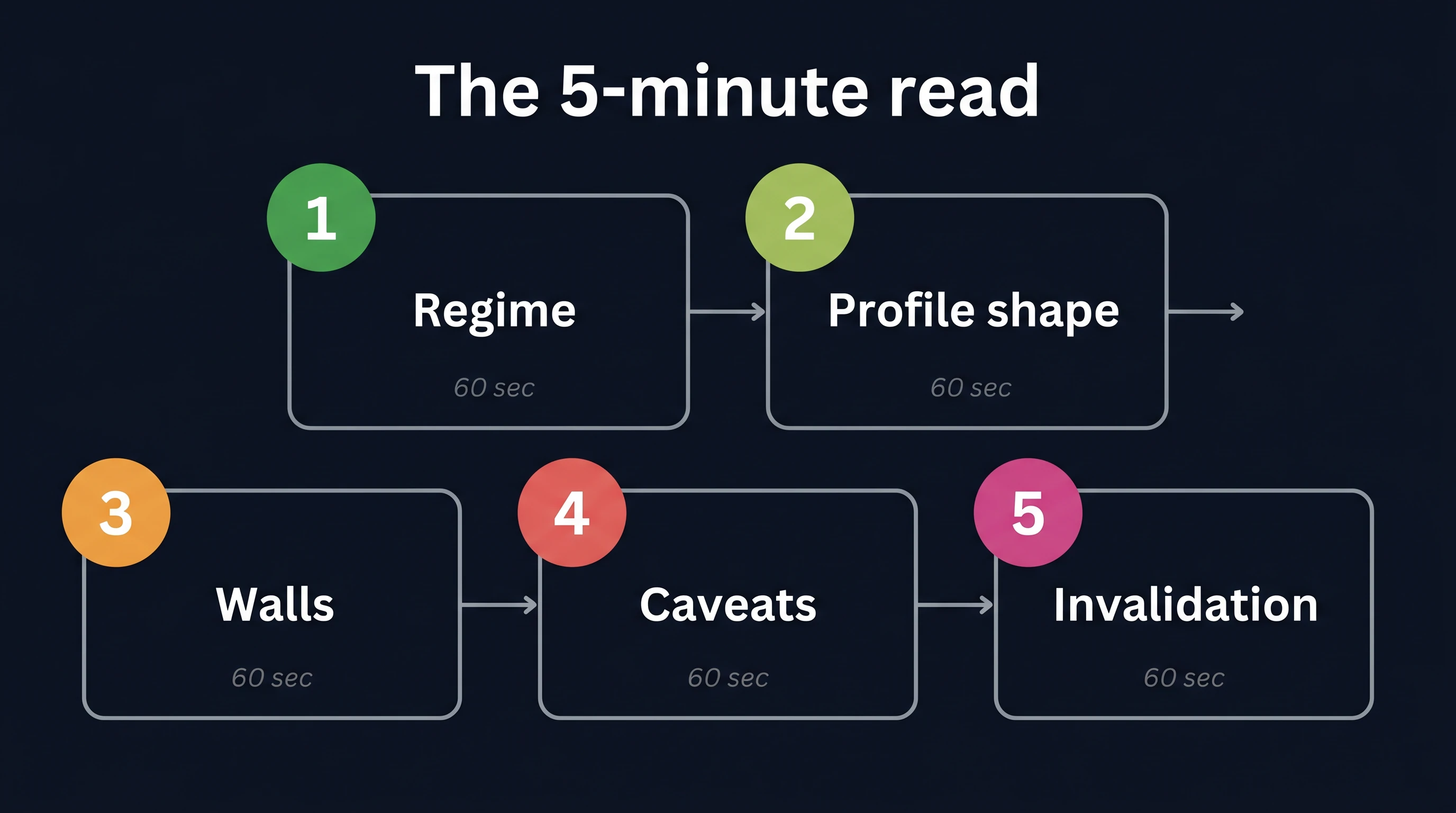
Step 1 — Regime (60 seconds)
Open the app, pick BTC, look at the GEX-by-Strike chart.
- Where is the Flip Point relative to current price?
- What is Net GEX — strongly positive, strongly negative, or near zero?
This is your regime call. Above the Flip with positive Net GEX → magnetize. Below the Flip with negative Net GEX → accelerate. Near the Flip or near-zero Net GEX → brittle, reduce conviction.
Say it out loud: "BTC is in a [magnetize / accelerate / brittle] regime." If you can't, you don't have a read yet.
Step 2 — Profile shape (60 seconds)
Look at the chart's overall shape, not just the levels:
- Is the green concentration heavier above or below current price? That tells you which direction has the most stabilizing structure.
- Is there a single dominant tall bar, or are bars more evenly distributed? Concentrated structure is more reliable than smeared structure.
- Is the negative-gamma side mostly close-by or far-off? Close negative bars matter more than distant ones.
This shapes your bias inside the regime call.
Step 3 — Nearest walls (60 seconds)
Find the closest meaningful bars on each side of current price.
- Nearest wall above — what strike, what color (green = stall, red = accelerate)?
- Nearest wall below — same questions.
These are your candidate levels for the session. In a magnetize regime, the green walls are likely targets. In an accelerate regime, the red walls are breakout zones, not targets.
Step 4 — Caveats (60 seconds)
Run the disqualifier checklist before committing to the read:
- Low OI? Look at the Term Structure or OI panel. If OI is thin, GEX is unreliable.
- Near expiration? Within 24 hours of a Friday 08:00 UTC, the profile is in late-stage gamma concentration. Expiration reset will redraw it.
- Macro event today? CPI, FOMC, major regulatory headlines — set the read aside until the event passes.
- Exchange disagreement? Switch the exchange selector. If Deribit and Bybit disagree meaningfully, your read is venue-specific, not market-wide.
Any caveat triggered → reduce conviction or set the read aside.
Step 5 — Invalidation (60 seconds)
Define the price action that would prove the read wrong.
- "Read holds while price stays above the Flip at $80,500."
- "Read invalidated by a clean close below $80,500 on 4-hour candles."
- "Read invalidated by a CPI surprise > 0.3% deviation from consensus."
Without this step you don't have a falsifiable read. With it, you have a hypothesis you can size risk against.
Worked example
Here's the 5-step read applied to a live BTC snapshot. Walk through the numbered callouts on the chart as you read.
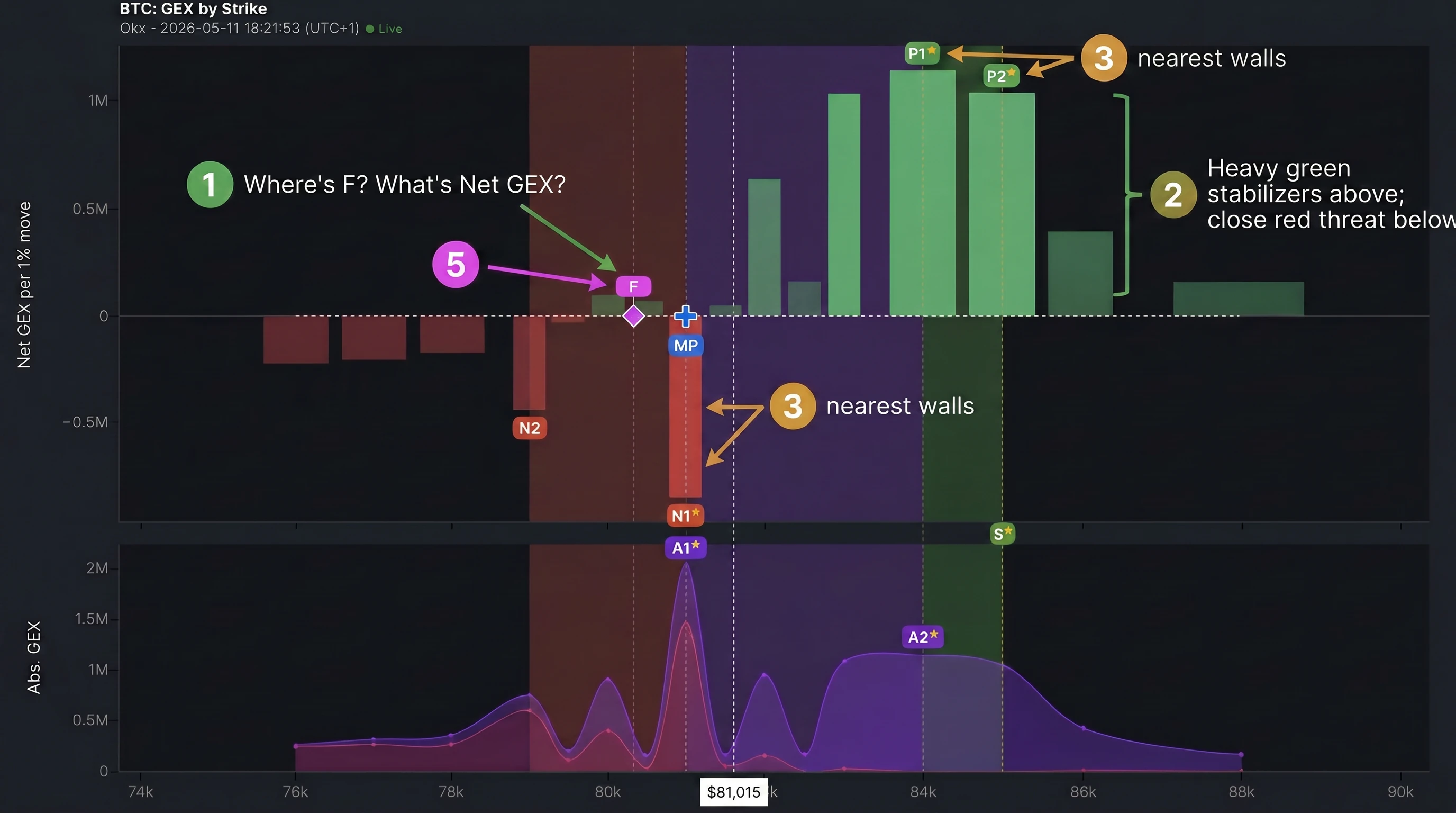
① Regime. Spot at $81,015. F (the magenta diamond) sits at ~$80,500 — price is barely above the Flip. Net GEX is positive on the upper side but the margin is thin. Magnetize regime, but brittle.
② Profile shape. Heavy green stabilizers cluster $3K above spot — P1 at $84K and P2 at $85K dominate the right side. But a tall red bar (N1) sits right next to spot at $81K. Asymmetric, and the close-by red side makes the magnetize call structurally weak.
③ Walls. Nearest stabilizing wall above: P1 at $84K. Closest threat below: N1 at $81K — effectively at spot — then N2 further down at $79K.
④ Caveats (off-chart by design). Today is Monday — Friday expiry is 4 days away, so we're not in the late-stage gamma concentration window. OI looks healthy across the curve (Term Structure panel confirms). No major macro events on the calendar. OKX shown here — cross-check Deribit before committing.
⑤ Invalidation. A clean 4-hour close below F ($80,500) flips the read to accelerate. While spot holds above $80,500, the brittle-magnetize read stands.
That's the read. Five minutes, end to end. You're not predicting the next candle — you're naming the structural backdrop you're trading inside.
What the read isn't
It's not a trade. The read tells you the regime and the levels. Your trading plan converts that into entries, stops, and sizing.
It's not a forecast. GEX is a snapshot. The read describes the current structural state. Tomorrow you re-read.
It's not a substitute for risk management. A wrong read with proper invalidation costs little. A right read without invalidation can still cost you on noise.
What's next
You've finished the Options Curious track. The most valuable next step is reps:
- Practice — open the app every morning, run the 5-step read, write your invalidation level on a sticky note, and check it the next day. Repetition builds the read.
- Track 3 — Active Options Trader (in development) — will go into the four chart types and additional markers in depth.
- Track 4 — Pro / Quant (in development) — will cover snapshot-vs-forecast limits, multi-exchange disagreement, and building a personal GEX playbook.
The mechanism is no longer mysterious. The chart is a map of forced dealer behavior. Your job from here is reps.
Regime, Profile, Levels, Caveats, Invalidation. Five minutes. Every day.
Check your understanding
Walk through the 5-step read, in order.
(1) Regime: where is price vs the Flip Point and what is Net GEX? (2) Profile: shape of the gamma profile — concentrated or spread, heavier above or below? (3) Levels: nearest stabilizing wall above and below current price? (4) Caveats: low OI, near expiration, settled contracts, macro events? (5) Invalidation: what specific price action would change the read?
Why is step 5 — invalidation — non-negotiable?
Without a defined invalidation level, you can't tell the difference between 'my read is wrong' and 'the market is being noisy'. A read with no invalidation is just an opinion. A read with one is a falsifiable hypothesis you can act on with sized risk.
What does the read produce — a trade or a thesis?
A thesis. The 5-minute read tells you the structural regime, the levels of interest, and the conditions that would invalidate the read. It does not tell you to enter at a specific price, size a position, or pick a stop. Combine the read with your own setup and risk rules — the read is the structural backdrop, not the trigger.