
The Flip point: sticky vs. jumpy regime
Know how to identify your regime in seconds and adjust your trading bias accordingly.
The single most important piece of information on a GEX chart isn't a level. It's a regime.
A regime tells you whether the market currently fights moves or feeds them. Getting this right changes everything about how you trade: where you take profit, how you size, whether you fade or follow.
The Flip point is where that regime lives.
What the Flip point is
The Flip point is the price level where net gamma crosses zero. Above it, the market is net positive gamma. Below it, net negative gamma.
You don't need to know what gamma is to use this. Here's the trader translation:
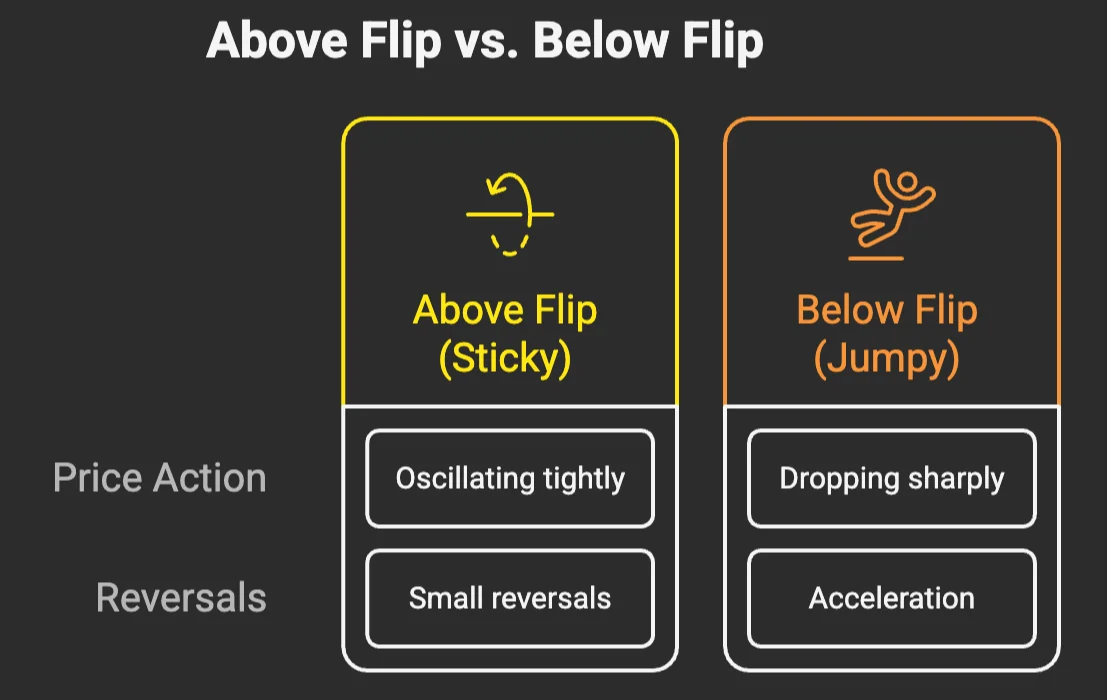
Above the Flip = sticky market. Price hugs levels, mean-reverts, compresses into ranges. Breakouts tend to fail. Levels hold more often than not.
Below the Flip = jumpy market. Price trends, extends, overshoots. Levels break. Moves carry further than expected.
Reading it in 5 seconds
Open GammaFlip. Find the thin horizontal marker labeled F on the chart. It's the line where green territory ends and red territory begins.
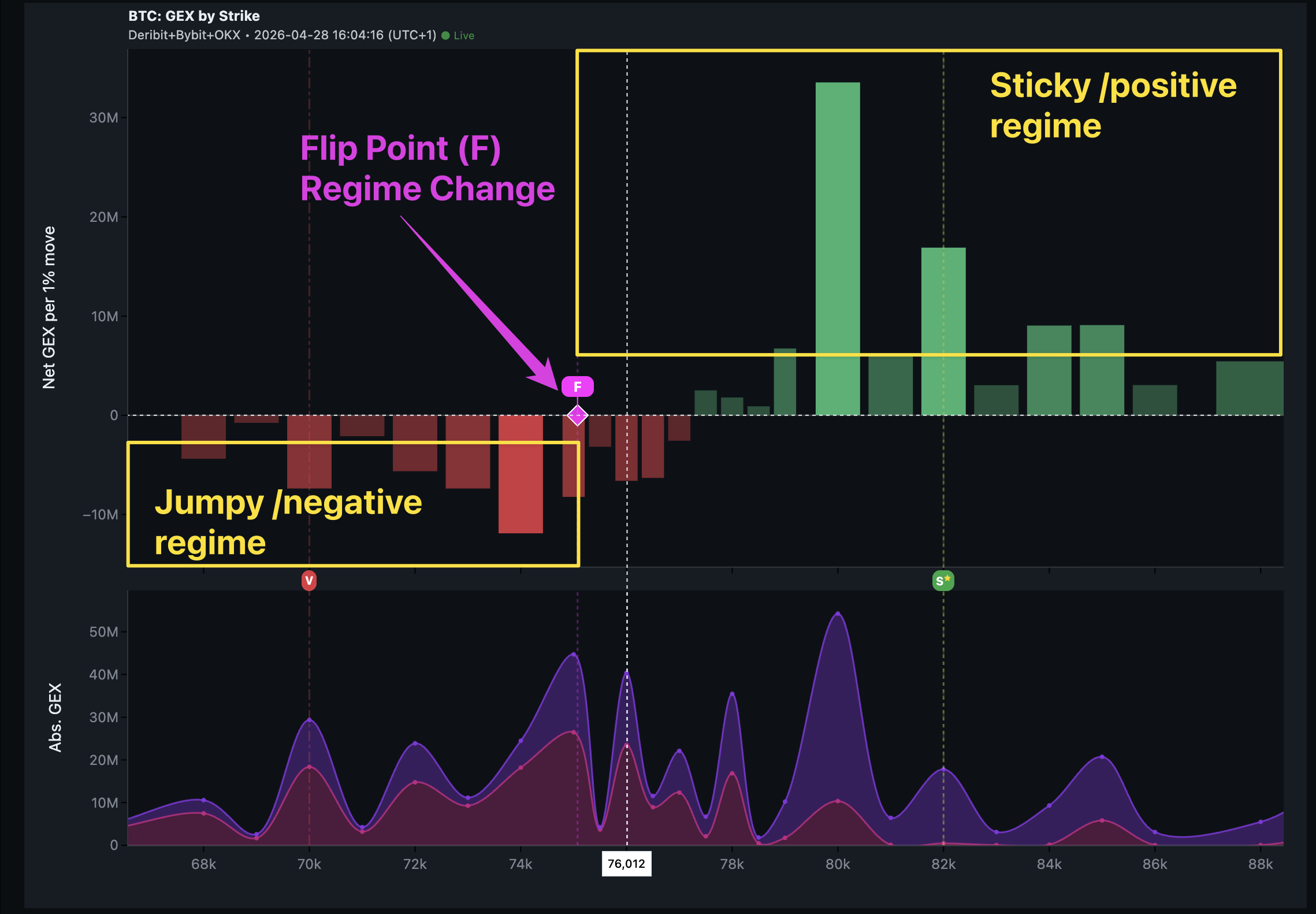
- Is the current price above F? → Sticky regime.
- Is the current price below F? → Jumpy regime.
That's it. Five seconds.
Sticky regime: how to trade it
In a sticky market, structure matters more than momentum.
What to do: - Take profits at major walls (P1/P2 — you'll meet them in the next lesson) - Buy dips that come back to strong green levels - Fade moves that approach extreme levels without momentum - Tighten stops — extended moves are less likely to follow through
What to avoid: - Chasing breakouts that haven't confirmed with volume - Holding through a major green wall expecting continuation
In sticky regimes, GEX walls act like elastic bands. Price can push through them momentarily, but it tends to snap back. The wall is not an absolute barrier — it's a high-probability reversal zone.
Jumpy regime: how to trade it
In a jumpy market, momentum matters more than structure. GEX levels still exist, but they're less reliable as reversal points — they're more likely to become acceleration zones.
What to do: - Follow momentum in the direction of the trend - Use GEX levels as targets, not reversal entries - Widen stops — moves extend more than expected - Be especially careful near the Flip point (now overhead resistance)
What to avoid: - Fading moves expecting mean-reversion - Assuming levels will hold the way they would in a sticky market
In a jumpy regime, the worst trade is a take-profit into a level that breaks and continues. The second worst is a mean-reversion entry that becomes a slow grind against you.
The regime change signal
Watch for price crossing the Flip point — this is a legitimate regime change signal, not just a level.
When price breaks above the Flip:
- Market transitions from jumpy to sticky
- Moves tend to slow and compress
- Old support/resistance levels start to matter more
When price breaks below the Flip:
- Market transitions from sticky to jumpy
- Expect increased volatility and trend extension
- The Flip itself often becomes resistance on the way back up
The strongest signal is a clean close above or below the Flip with follow-through, not a wick through it. Wicks through the Flip in an otherwise intact regime are common noise.
Putting it together
Before any trade, check two things:
- Where is the Flip point relative to current price? → This gives you your regime.
- Am I trading with or against the regime? → A mean-reversion trade in a jumpy market is structurally fighting the tape.
The regime doesn't guarantee the trade works. But it tells you which type of trade has the structure behind it. In a sticky market, fading is favored. In a jumpy market, following is favored.
Next lesson: the actual walls — where price stalls in a sticky regime and how to use them as your edge.
Check your understanding
BTC is trading at $95,000. The Flip point is at $92,000. What regime are you in?
Positive gamma (sticky) regime — price is above the Flip. Favor range-bound strategies: take profits at resistance, buy dips at support. Avoid chasing breakouts.
Price has been grinding in a tight range for 4 hours. You check GammaFlip and see the Flip point is $2,000 above current price. What does this suggest?
Price is below the Flip in a negative gamma (jumpy) regime. The tight range may be coiling for a directional move. The Flip point overhead is now a resistance zone — a clean break above it would be a regime change signal.
You're in a positive gamma regime and set a take-profit at P1. Price reaches P1 and pauses. Do you hold or take profit?
Take profit, or at least reduce size. P1 is a strong stabilizing wall — the market structure is working against you holding through it. If price rejects hard from P1 in a positive regime, that rejection tends to be sticky too.